
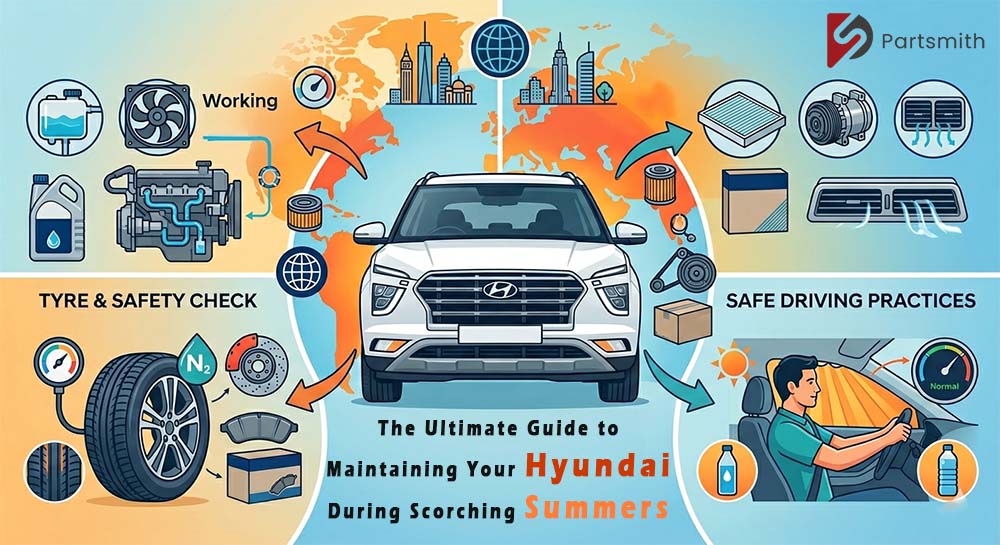
As global temperatures continue to rise, summer presents a significant challenge for vehicle owners. Hyundai vehicles are engineered with precision and advanced technology to handle diverse climates, but extreme heat can take a toll on even the most robust machines. Whether you are driving a Tucson, Creta, Elantra, or an i20, understanding how to manage heat-related issues is crucial for longevity and safety.
In high-temperature environments, the engine's primary enemy is overheating. The cooling system's job is to dissipate the immense heat generated by internal combustion and friction.
The coolant (antifreeze) isn't just for winter; it raises the boiling point of the water in your radiator. During summer, ensure your coolant level is at the 'Full' mark. Using Genuine Hyundai Long-Life Coolant is essential because it contains specific additives that prevent corrosion in the aluminum components of modern Hyundai engines.
Over time, the radiator fins can get clogged with debris, insects, and dust, reducing its efficiency. A gentle wash with a low-pressure hose can clear these blockages. Furthermore,
listen for the radiator fan. It should kick in once the engine reaches a certain temperature. If it fails, your engine could reach critical temperatures within minutes of idling.
A malfunctioning AC in peak summer isn't just uncomfortable; it’s a health risk. To ensure your Hyundai stays a "fridge on wheels," follow these steps:
The cabin air filter (also known as the pollen filter) is often overlooked. A clogged filter restricts airflow, making the blower motor work harder and reducing cooling efficiency. Replacing this every 10,000 km is recommended, especially in dusty environments.
The AC condenser is usually located right in front of the radiator. If it is dirty, the refrigerant cannot release heat effectively. Ensure it is free of dirt to allow maximum heat exchange.
When your car has been parked in the sun, the interior temperature can reach over 60°C (140°F). Do not turn the AC to 'Max' immediately. Instead:
Heat causes the air inside your tyres to expand. For every 10°C rise in temperature, tyre pressure increases by about 1-2 PSI.
Under-inflated tyres flex more, generating even more internal heat, which can lead to a blowout. Conversely, over-inflated tyres reduce the contact patch, affecting braking. Always
stick to the PSI levels mentioned on the driver-side door jamb. Check pressures early in the morning when the tyres are "cold."
Consider switching to Nitrogen. Nitrogen molecules are larger (less leakage) and do not retain heat as much as compressed atmospheric air, keeping your tyres cooler on long highway drives.
Contrary to popular belief, heat is harder on batteries than cold. High temperatures accelerate the chemical reaction inside the battery, leading to overcharging and internal corrosion. It also causes the battery fluid to evaporate.
When a part fails due to heat, the temptation to buy a cheap, third-party replacement is high. However, for a Hyundai, "Genuine" is the only way to go for several reasons:
|
Non-genuine filters might look the same but use inferior filtration media. A cheap oil filter might collapse under high heat, leading to total engine failure. Genuine Hyundai parts are tested under extreme "Hot Weather" cycles to ensure they don't deform or lose integrity.
|
|
Using Genuine parts keeps your warranty intact. Parts like Hyundai Genuine Brake Pads are designed to handle the specific "heat fade" characteristics of your car's weight and braking system, ensuring you stop in time even when the rotors are glowing hot.
|
Driving in summer requires a different mindset.
Summer car care is about proactive maintenance. By ensuring your cooling system is flushed, your tyres are correctly pressured, and you are using Genuine Hyundai Spare Parts, you can enjoy a stress-free driving experience regardless of the mercury levels. Your Hyundai is a high-performance machine; treat it with the care it deserves, and it will keep you cool all summer long.