
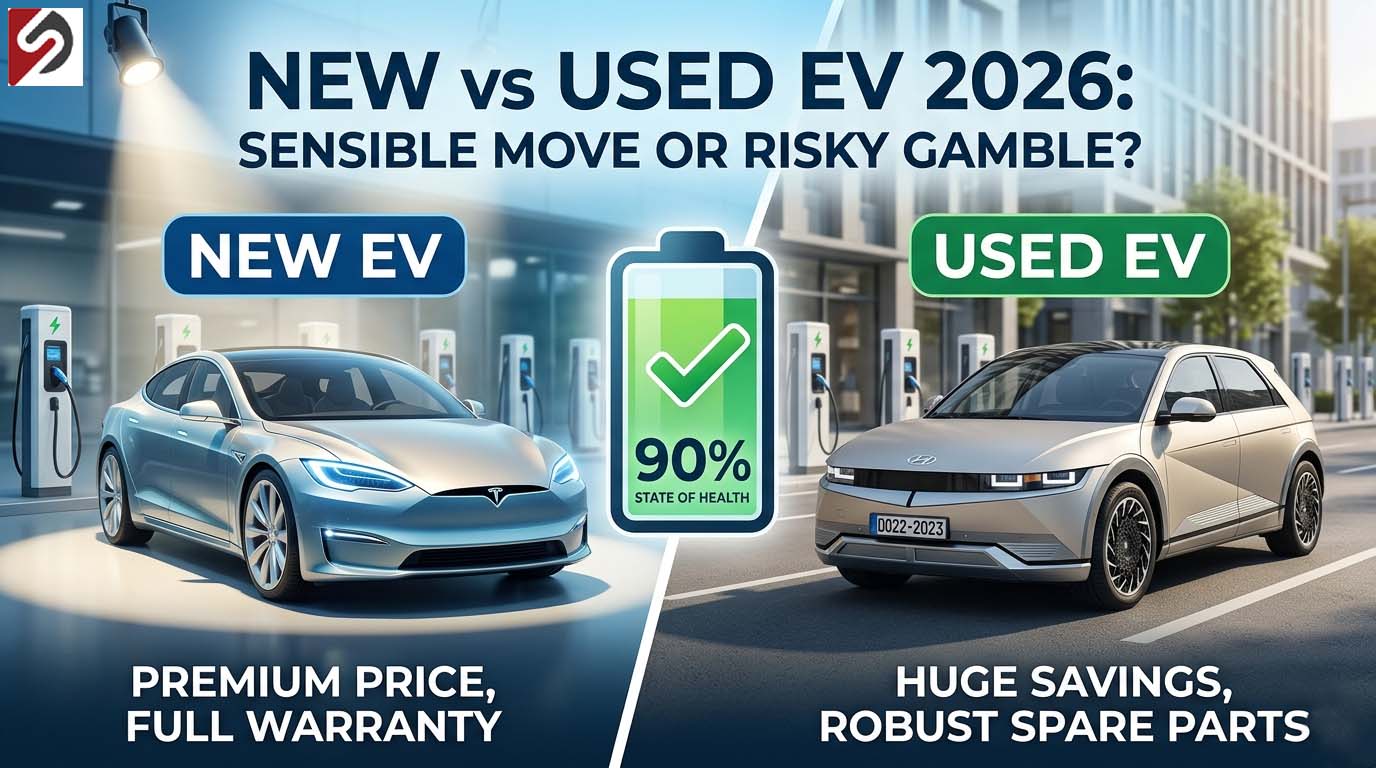
If you walked into a car dealership five years ago and asked for a used electric vehicle (EV), the salesperson probably would have looked at you like you were asking for a flying carpet. Back then, EVs were the "new shiny toys" for early adopters.
Fast forward to 2026, and the script has flipped. The roads are humming with silent motors, and the second-hand market is finally booming. But the big question remains: Is it actually wise to buy a used EV right now, or are you just inheriting someone else’s battery headache?
Let’s break down the pros, the cons, and the reality of spare parts in 2026.
In 2026, we are seeing the first massive wave of 3-to-5-year-old EVs hitting the resale market. These are the cars bought during the 2021-2023 EV gold rush. Because technology moves fast, these cars have depreciated significantly.
For a buyer, this is a goldmine. You can often pick up a premium EV for the price of a mid-range petrol car. But "cheap" doesn't always mean "good value."
1. The Battery Boogeyman: Is it still a risk?
The biggest fear used to be: "What if the battery dies?"
In 2026, we have enough data to know that EV batteries are much heartier than we thought. Most modern lithium-ion and LFP (Lithium Iron Phosphate) batteries from 2022 onwards are easily hitting 200,000 to 300,000 kilometers with minimal degradation.
Pro-Tip: When buying used in 2026, always ask for a State of Health (SoH) report. If the battery is at 90% health after four years, that car is a steal.
2. The Spare Parts Situation: No More Waiting for Months
Two years ago, if you broke a side mirror or a sensor on an EV, your car might sit in the garage for two months waiting for a part from overseas.
|
Feature |
New EV (2026 Model) |
Used EV (2022-2023 Model) |
|
Price |
Premium / High |
40-60% cheaper |
|
Range |
600km+ (Average) |
300km - 400km (Average) |
|
Tech |
AI-Integrated, Level 3 ADAS |
Standard Autopilot / Level 2 |
|
Depreciation |
Hits you hard on Day 1 |
Already "bottomed out" |
|
Spare Parts |
Easy but expensive |
Widely available & affordable |
One of the smartest reasons to buy a used EV in 2026 is that the supply chain for components has matured. When you buy a used car, you expect things to wear out. Here is the 2026 reality of EV maintenance:
The Tech Gap has Flattened
Between 2015 and 2020, EV tech changed every six months. If you bought an old one, it felt like using an iPhone 4 in a world of iPhone 13s.
However, between 2022 and 2026, the tech has reached a "plateau." A 2023 Tesla or Hyundai Ioniq still feels incredibly modern today. You aren't "settling" for old tech; you're just paying less for the same core experience.
Charging Infrastructure is Everywhere
In the past, you needed a new EV with the biggest battery possible because chargers were rare. In 2026, charging stations are as common as ATMs. You don't need a 700km range car for city driving anymore, which makes older, shorter-range (300km) used EVs much more practical and incredibly cheap.
The Verdict: Is it Sensible?
Yes. Buying a used EV in 2026 is arguably the smartest financial move for a daily commuter.
You avoid the "Depreciation Cliff" (where a new car loses 20% value the moment you drive it home). You get a vehicle with fewer moving parts than a petrol car, meaning fewer things go wrong. And with the 2026 spare parts ecosystem being so robust, you aren't stuck waiting for parts anymore.
If you want the "New Car Smell" and 200 extra kilometers of range that you’ll probably never use, buy new. But if you want a premium driving experience for the price of a budget hatchback, the used EV market is where the magic happens.