
Construction companies, infrastructure contractors, mining businesses, and equipment rental firms all have one thing in common—they rely on dependable machinery to complete projects efficiently. While purchasing brand-new equipment may seem appealing, many businesses today prefer to Buy Used Construction Equipment because it offers exceptional value, faster availability, and lower capital investment.
However, buying pre-owned heavy machinery requires careful evaluation. A well-maintained machine can serve your business for years, while a poor purchase may lead to expensive repairs, downtime, and lost productivity.
At Partsmith, we help businesses source high-quality used construction machinery that meets international standards. Whether you are searching for Backhoe Loaders for Sale, Cranes for Sale, excavators, graders, or wheel loaders, making an informed buying decision is the key to maximizing your investment.
The global demand for used heavy equipment continues to grow because construction companies want reliable machinery without the premium cost of new models. Modern construction equipment is built to last, making well-maintained used machines an excellent choice for contractors of all sizes.
Apart from affordability, used equipment often comes with immediate availability, helping companies avoid long manufacturing lead times. Businesses working on tight project schedules can quickly deploy machinery and maintain productivity.
However, every purchase should begin with a detailed inspection rather than focusing only on price.
The first impression matters, but never judge equipment only by its appearance.
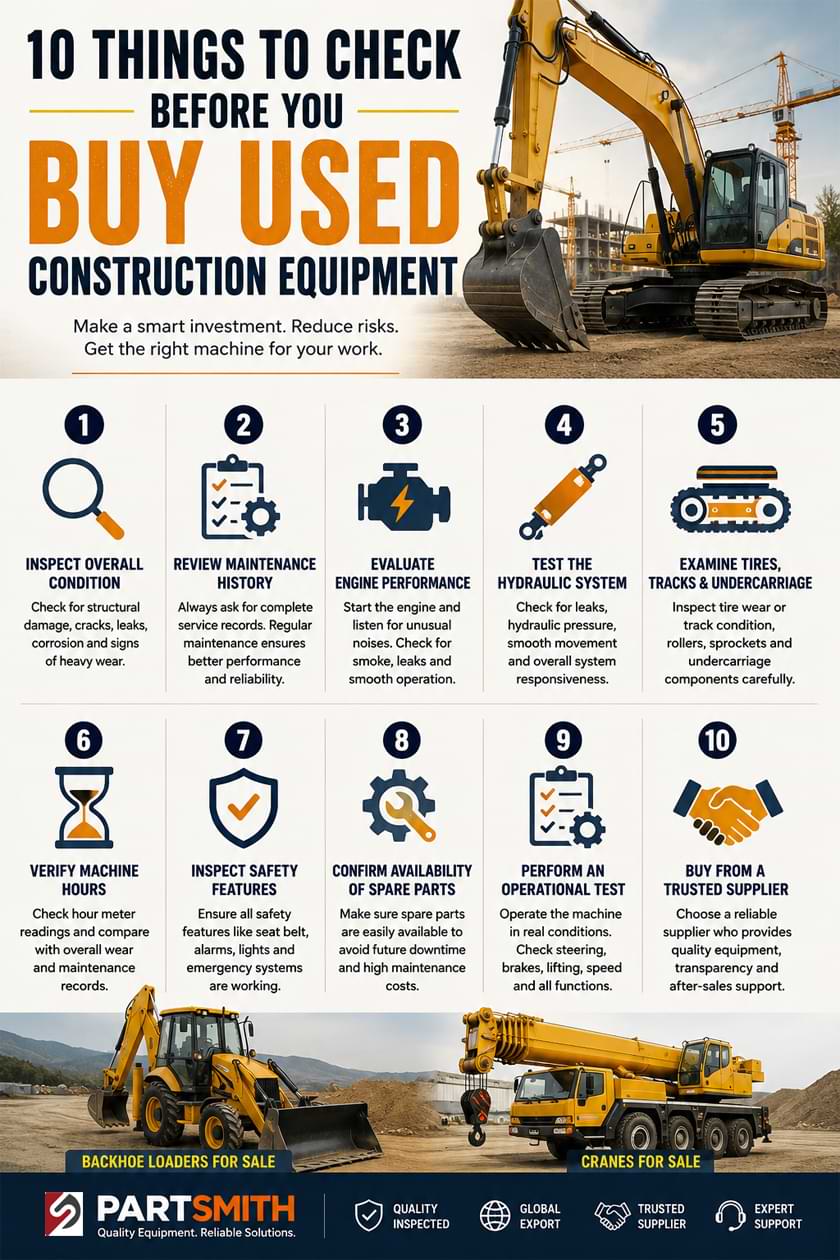
Look closely at the entire machine for signs of excessive wear, structural damage, corrosion, poor-quality welding, or evidence of major accidents. Cosmetic scratches are expected, but bent frames, cracked booms, or damaged chassis can indicate deeper mechanical issues.
Pay attention to:
Inspect the structural frame for cracks, repairs, or stress points.
Hydraulic cylinders should be free from dents, leaks, and excessive rust.
Check whether attachments fit properly without unusual movement.
A well-maintained machine usually reflects responsible ownership and proper servicing.
Maintenance records tell the story that appearances cannot.
Ask for documented service history, including:
Consistent maintenance generally indicates that the equipment has been professionally cared for throughout its working life.
Machines with incomplete service records deserve extra attention during inspection.
The engine is the heart of every construction machine.
Start the engine from cold if possible. Listen carefully for unusual noises, excessive vibration, knocking, or inconsistent idle speed.
Check for:
Healthy engines start smoothly and operate consistently without excessive smoke or overheating.
Hydraulic systems power nearly every major function in heavy equipment.
Weak hydraulic performance often results in slower operations and reduced productivity.
During inspection, verify:
Even small hydraulic leaks may develop into expensive repairs if ignored.
The undercarriage is one of the most expensive components to replace.
Depending on the equipment type, inspect either tires or tracks carefully.
Check tire wear patterns, sidewall damage, and tread depth.
Inspect:
Uneven wear often indicates alignment or suspension problems.
Operating hours provide valuable insight into machine usage.
However, hours alone do not determine equipment quality.
A machine with higher hours but excellent maintenance may outperform another with fewer hours but poor servicing.
Compare:
Excessive wear with unusually low hours may indicate meter replacement or inaccurate readings.
Construction safety should never be compromised.
Before purchasing, ensure the equipment includes functioning safety components.
Important safety checks include:
Machines intended for international export should also comply with applicable safety regulations.
One of the biggest advantages of purchasing popular equipment models is easier access to replacement components.
Before finalizing your purchase, verify that:
Reliable spare parts availability reduces future maintenance downtime significantly.
A visual inspection is never enough.
Whenever possible, operate the machine under working conditions.
Observe:
Operational testing often reveals problems that remain hidden during static inspections.
Perhaps the most important decision is choosing the right equipment supplier.
Established exporters inspect machinery carefully before offering it for sale. They provide transparent information, quality assurance, and professional support throughout the buying process.
Working with an experienced supplier reduces purchasing risks and increases confidence, especially for international buyers.
At Partsmith, every machine is selected with quality, performance, and reliability in mind. Our team helps businesses source dependable construction equipment suitable for projects across various industries and regions.
Construction projects require different machines depending on site conditions and project size.
Versatile and highly productive, Backhoe Loaders for Sale remain one of the most requested categories in the construction industry. They combine excavation, loading, trenching, grading, and material handling into one efficient machine.
Their ability to perform multiple tasks makes them ideal for road construction, utility projects, municipal work, agriculture, and commercial developments.
Heavy lifting requires precision, stability, and dependable engineering. Businesses looking for Cranes for Sale should carefully inspect lifting capacity, boom condition, hydraulic systems, wire ropes, outriggers, and overall structural integrity.
Well-maintained cranes improve lifting efficiency while helping reduce operational delays on construction and industrial sites.
Partsmith also supplies a wide range of dependable used machinery, including:
Each machine category serves different project requirements, making professional guidance valuable when selecting equipment.
Purchasing used construction machinery should be based on reliability rather than simply finding the lowest price.
Partsmith supports contractors, equipment dealers, mining companies, and infrastructure developers by offering carefully sourced machinery that delivers dependable performance.
Our commitment includes:
Whether you need a single machine or an entire fleet, our experienced team helps you identify equipment that aligns with your operational requirements and budget.
Choosing to Buy Used Construction Equipment is a strategic decision that can significantly reduce project costs while maintaining productivity. The key lies in evaluating every machine carefully rather than making decisions based solely on price.
From inspecting structural components and hydraulic systems to reviewing maintenance records and verifying spare parts availability, each step contributes to a smarter investment. Equipment such as Backhoe Loaders for Sale and Cranes for Sale can provide years of reliable service when sourced from a trusted supplier.
At Partsmith, we understand that every construction project depends on dependable machinery. Our carefully selected inventory, industry expertise, and commitment to quality help businesses invest with confidence. Whether you are expanding your fleet or replacing existing equipment, choosing the right used machine today can deliver stronger performance, lower operating costs, and greater long-term value for every project.